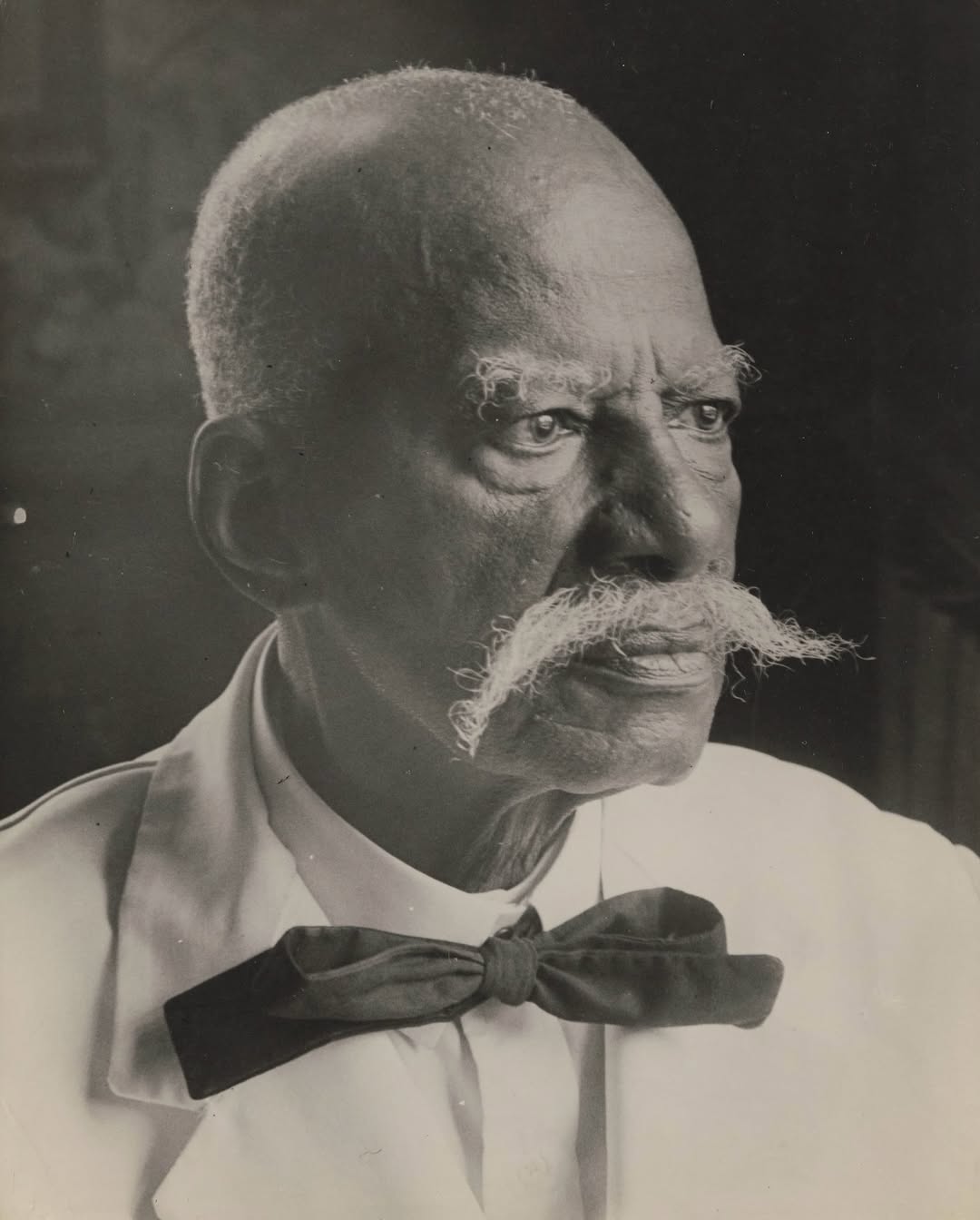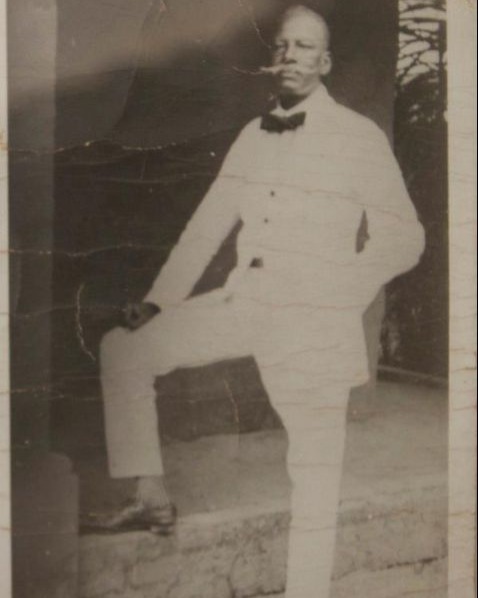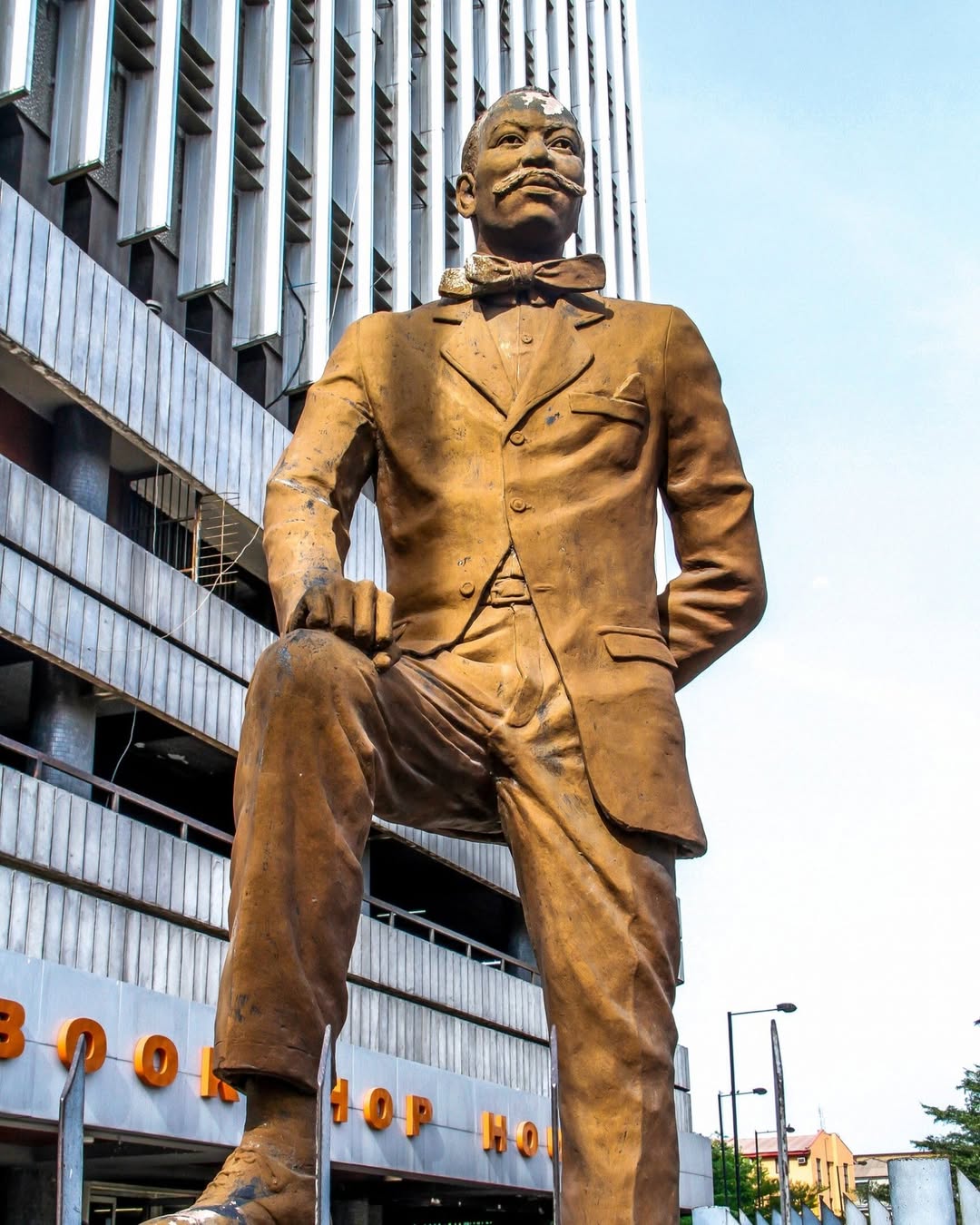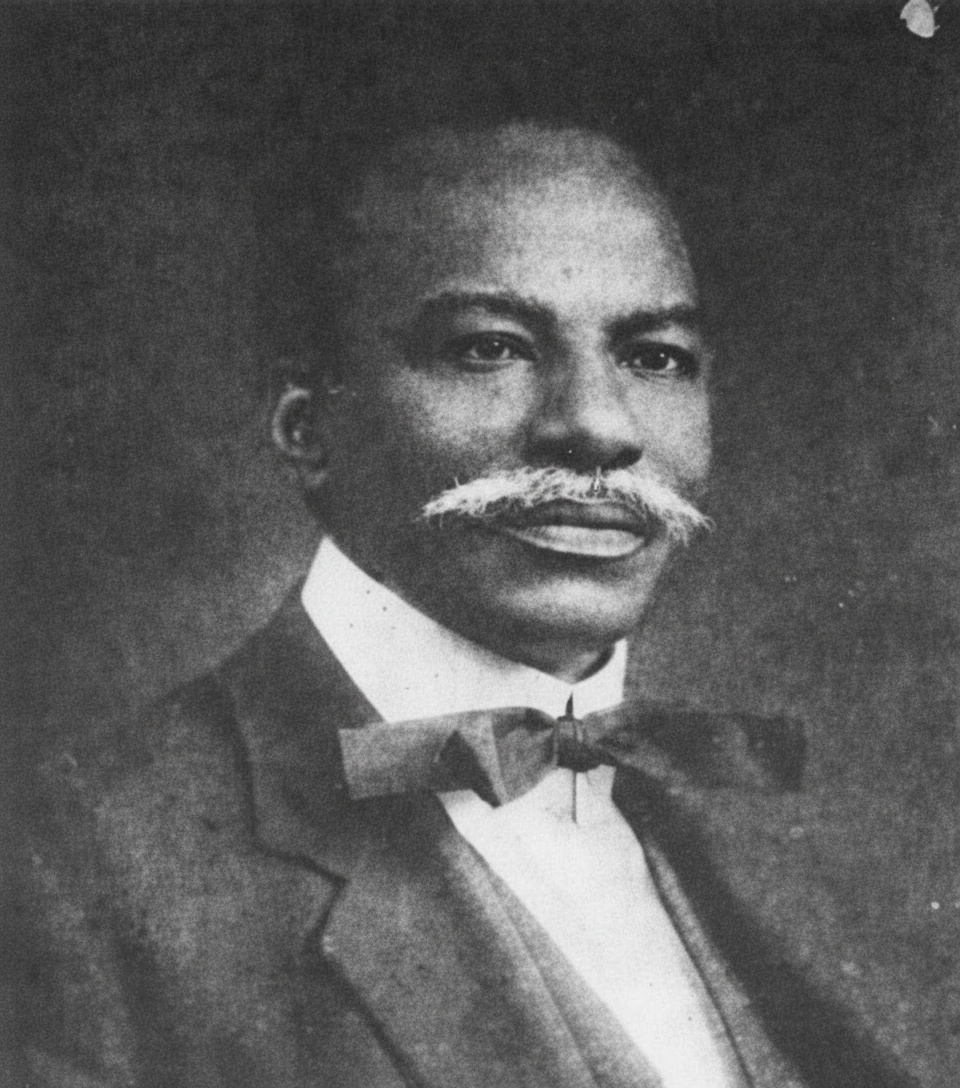
Herbert Macaulay
tells his own story.

Prologue:
The Seed of a Nation

I, Olayinka Herbert Samuel Heelas Badmus Macaulay, have been called many things in my lifetime: engineer, journalist, nationalist, agitator, and even “the father of Nigerian nationalism.” But if I were to define myself, I would say I am simply a witness to the birth pangs of a nation, a reluctant revolutionary who loved his people enough to challenge an empire.

Royal Beginnings (1864-1877)

I was born in Lagos on November 14, 1864, into the distinguished Macaulay family, a lineage that connected me to the very fabric of Lagosian aristocracy. My father, Thomas Babington Macaulay, was the founder and first principal of the Church Missionary Society (CMS) Grammar School in Lagos—the first secondary school in Nigeria. He was a man of discipline and learning, a product of the missionary zeal that swept through West Africa.

But it was my mother, Abigail Crowther Macaulay, who connected me to true Yoruba royalty. She was the daughter of Samuel Ajayi Crowther, the first African Anglican bishop, himself a recaptive slave who rose to monumental heights. Through my maternal grandmother, I was descended from King Abiodun of the Oyo Empire, a lineage that instilled in me a deep sense of history and sovereignty long before the British declared their “protection.”

My childhood in the Lagos of the 1860s and 1870s was a unique intersection of Victorian English education and vibrant Yoruba culture. I grew up speaking Yoruba at home but studied Latin and Greek at my father’s school. I witnessed the gradual but unmistakable shift from Lagos as a bustling African port city to Lagos as a British Crown Colony (which it became in 1861, three years before my birth).

Engineering a Future (1877-1893)

In 1877, at age thirteen, I began working as a clerk in the Lagos Public Works Department. But my mind was drawn to building, not bureaucracy. My talent for mathematics and design was recognized, and in 1881, I received a rare opportunity—a scholarship to study civil engineering in England.
 
For three years at Plymouth and Truro in Cornwall, I immersed myself in the science of construction, surveying, and architecture. I was the first Nigerian to become a qualified civil engineer. When I returned to Lagos in 1884, I was appointed Surveyor of Crown Lands for the Colony of Lagos—the highest position an African could hold in the technical service at that time.
 
For nearly a decade, I mapped Lagos, designed buildings, and oversaw infrastructure projects. But with each survey, I became more aware of how British land policies were systematically dispossessing indigenous landowners. My engineering career, which began as a point of pride, slowly became an education in colonial appropriation.

The Awakening (1893-1908)

The turning point came in 1893, when I resigned my government position after a dispute over my rights to private practice. This break from colonial employment was my first act of defiance. My political awakening, however, crystallized around two major crises:

The Water Rate Agitation (1908):

The British colonial government attempted to impose a water rate on Lagos residents, claiming it was for pipe-borne water infrastructure. I saw this as taxation without proper representation or service. Through my writings in the Lagos Daily News, which I founded, I mobilized the public. We organized protests, and I led a delegation to London—the first of many such delegations I would lead. The campaign was successful; the water rate was suspended. I learned the power of organized protest and journalism.

The Lands Controversy:

More personally galling was the systematic seizure of African lands under the pretext of “Crown Lands.” My own family properties were threatened. I began studying law texts, becoming a self-taught expert on land tenure. I fought countless cases for families whose lands were being confiscated, often without payment. This cemented my reputation as the defender of Nigerian property rights against colonial encroachment.

The Pen as Sword: Journalism & Early Nationalism (1908-1922)

I founded The Lagos Daily News in 1920, Nigeria’s first daily newspaper. Its motto was “Truth, Justice, and Fair Play.” Through its pages, I did not just report news—I educated Nigerians about their rights, exposed colonial injustices, and articulated a vision for self-determination.
 
My writings were sharp, factual, and fearless. I criticized the British administration’s education policies, health services, and economic exploitation. I was sued for libel multiple times and even imprisoned in 1928 for six months—a badge of honor I wore proudly.
 
During this period, I helped form early political organizations like the People’s Union (1908) and the Lagos Native Association. These were not yet mass movements but gatherings of educated elites, professionals, and traditional rulers who petitioned the government for reforms. I was the bridge between the educated elite and the masses, between the Christian Lagosians and the Muslim community, whose support I actively courted.

Founding the Nigerian National Democratic Party (1923-1934)

The Clifford Constitution of 1922, which allowed for limited African election to a Legislative Council, presented an opportunity. I believed we needed a proper political party to contest these seats and turn the council into a platform for nationalist agitation.
 
On June 24, 1923, I founded the Nigerian National Democratic Party (NNDP)—the first political party in Nigeria and indeed in British  Africa. Its objectives were clear: to achieve self-government for Nigeria, to promote higher education for Africans, and to secure  economic opportunities for Nigerians.
 
The NNDP dominated Lagos politics for the next fifteen years. We won every seat available to Africans in the Legislative Council elections from 1923 to 1938. I never held a seat myself—preferring to be the kingmaker rather than the king—but I directed the party’s strategy and ideology.
 

The Later Years: Coalition and Radicalization (1934-1946)

By the mid-1930s, a new, more radical generation of nationalists emerged. Young men like Nnamdi Azikiwe (“Zik”), who returned from America in 1937, criticized the NNDP as too moderate, too Lagos-centric, and too willing to work within the colonial system.
 
Initially, I saw “Zik” as a rival. His newspaper, The West African Pilot, competed with my Lagos Daily News. His rhetoric was more fiery, his vision pan-African. But true leadership requires recognizing when the tide is changing.
 
In 1944, I made perhaps my most significant decision: I put aside ego and joined forces with Azikiwe and others to form the National Council of Nigeria and the Cameroons (NCNC), Nigeria’s first nationwide nationalist organization. At age 80, I was elected its first President, with Azikiwe as Secretary. This coalition united the old guard with the youth, professionals with trade unionists, and people across regional and ethnic lines.
 

The Final Battle and Legacy (1946)

In 1946, the British government introduced the Richards Constitution, which proposed regionalization. The NCNC saw this as a “divide and rule” tactic that would fracture growing national unity. Despite my failing health, I agreed to lead an NCNC delegation to London to protest the constitution.
 
It was on this final mission for my country that my journey ended. On May 7, 1946, while in London preparing our case, I fell gravely ill. I passed away on May 7, 1946, at the age of 81, far from the Lagos soil I loved so dearly.
 
My body was brought home to a funeral of unprecedented scale. Thousands lined the streets of Lagos. I was buried at Ikoyi Cemetery, my tombstone a simple marker for a life lived in complex times.
 

Epilogue: Reflections

They say I was controversial—acerbic, stubborn, and sometimes autocratic in my leadership. I do not deny these charges. The fight for dignity requires a certain toughness. I made enemies, both British and Nigerian. My methods were not always diplomatic, but colonialism itself was not diplomatic.
 
I never lived to see the independent Nigeria I fought for—that came 14 years after my death in 1960. But I planted the seeds. I took nationalism from the realm of elite petitioning to mass political organization. I demonstrated the power of the press as a weapon of liberation. I showed that an African could stand toe-to-toe with the British Empire on matters of law, administration, and justice.
 
My greatest pride? That I helped transform the Nigerian from a “subject” to a “citizen” in his own mind. The journey is not complete—perhaps it never will be—but the direction was set.
 
I was Herbert Macaulay: engineer, journalist, agitator, and above all, a Nigerian.
“There is no place like Home, and no man is truly himself, truly free, or truly a man, until he stands on the soil of his ancestors, under the government of his own people, and by the light of his own conscience.”

Herbert Macaulay

Image gallery marquee